Introduction
When it comes to recommended diets for longevity, your heritage belongs in the conversation. Unfortunately, the advice for diets is always the same -consume a Mediterranean Diet. Do I love a plant-based diet with lots of olive oil, nuts, and fish? Yes! However as a Nigerian-American woman the dishes that feed my soul are not the same as Mediterranean diets. Only recommending the Mediterranean diet is exclusive instead of inclusive for a world/international community primed for healthy longevity. We have to do better and at Longevity Locus that’s what we’re going to do.
First, let’s give credit to the Mediterranean Diet. This diet has been researched for decades.1 You read that right, decades. Throughout the decades of research: living longer, decreased the number of new cases of cardiovascular events, and decreased risk factors for cardiovascular disease such as hypertension, elevated cholesterol, obesity, and metabolic syndrome were found to be associated with this diet1. Decreased cognitive decline including conditions such as vascular causes of dementia and Alzheimer’s Disease have all been found with consuming the modified Mediterranean diet called the MIND Diet1. Those are all significant and I believe that’s why it’s pushed so heavily. As we have explored before on Longevity Locus, many of what we think we know about aging isn’t the full picture.
The Reality
However, people should not have to reject a part of their cultural identity to live longer. The Mediterranean diet is heavily researched but it is not the only answer. In the longevity wellness space, other cultural diets are constantly overlooked or not mentioned. Such diets that are overlooked are belonging to Okinawa, Costa Rica, Nigeria & other African nations, Barbados, and India & Pakistan. These communities have people living into their 90s if not longer based on their cultural diets. Let’s “travel” around the world and explore them!
First up: Okinawa, Japan
Okinawa, Japan is special in the longevity world because this was once home to where the world’s longest-lived women resided.2
In Okinawa, Japan, people practice Hara Hachi Bu. This is an ideology in regards to how much a person should eat. Well the practice of Hara Hachi Bu encourages people to eat up to 80% full. The traditional Okinawan diet consists heavily of vegetables at 98% and fish at < than 1%.3 Those vegetables are: purple sweet potato known as Beni Imo 4, yellow & green vegetables, along with seafood, fruits, alcohol, teas, and spices.5 Beni Imo specifically has been recorded since the 17th century when it was introduced from Central and South America.6 This sweet potato is rich in anthocyanins which provides the purple color.7 This is the same compound that makes red grapes, red onions, black beans and other dark colored fruits and vegetables. Anthocyanins are powerful antioxidants which fight against oxidative stress.8
Unfortunately and currently, the Okinawan diet is not as widely practiced on a daily basis in Okinawa. This is because of the Westernization of their diet.9 There are more than 12 KFCs on the island of Okinawa. The Westernization of the Okinawa diet has led to increased weight and cardiovascular diseases.9 Fortunately, there are public health officials re-educating younger generations of Okinawans to return to their traditional diet for long term health benefits such as longevity.
Second: Nicoya, Costa Rica
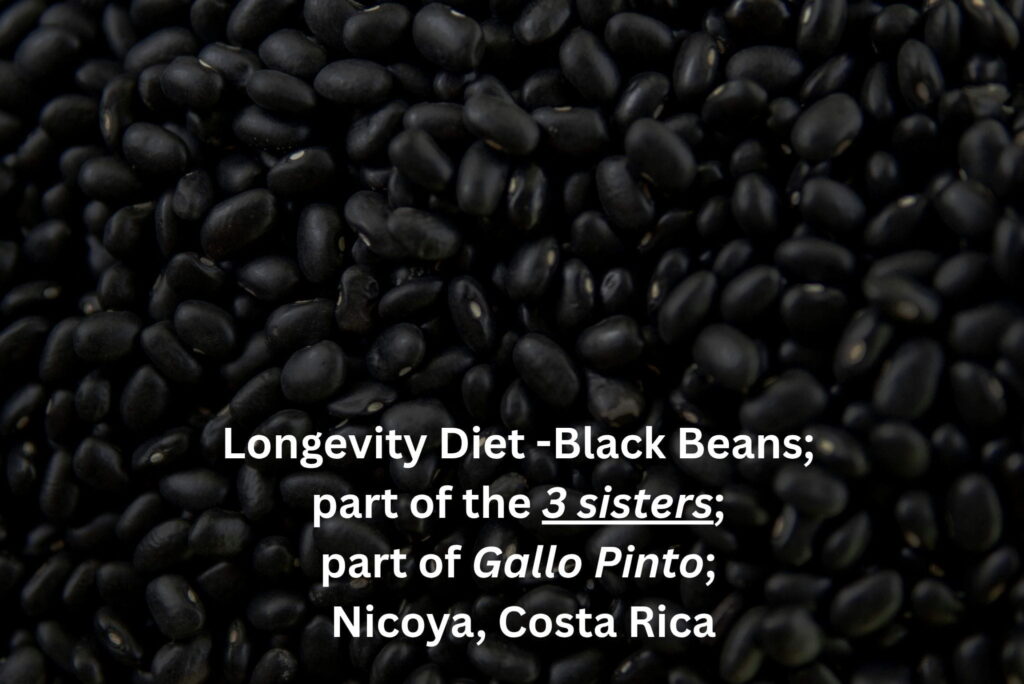
Costa Rica is famous for many things. It’s wild life, tropical forests, and the Nicoyans for being a Blue Zone population. In Nicoya, Costa Rica their diet is famous for beans and rice; black beans specifically. The dish is called Gallo Pinto and is a mixture of black beans, rice, pepper, and cilantro.10 Doesn’t that sound delicious! In the Nicoyan diet, there is a term called 3 sisters consisting of black beans, squash, & corn.11 Black beans are rich in fiber, protein, and antioxidants.12 The fiber manages blood sugar spikes. Protein helps build muscle mass which is important as people, especially women age. Antioxidants prevent free radicals and support the immune system.
Next is squash. Squash when prepared correctly can and does take on any flavor profile you wish; thus it can be included in your cultural diet. Squash is also rich in antioxidants, potassium, magnesium, iron, along with vitamins A, B, and C. These characteristics of squash when broken down into nutrients lead to decreased oxidative stress. The decreased oxidative stress decreases the risk of chronic disease and cancers, supports skin, heart, bone, and blood health as well.11,13
Last but not least is corn. Corn has many health benefits such as containing fiber and antioxidants. Additionally, corn supports both eye and gut health.14 The people of Nicoya, Costa Rica also consume very anti-oxidant rich fruits. Such fruits are oranges, bananas, guavas, berries, papaya, watermelon, grapes, lemons, passion fruit and cantaloupe.15 The fruit studied to provide the most polyphenols (which is protective in aging) is papaya.4
Third: The Traditional West African/African Diets
While I was growing up, West African food was food. There was no special name. It was the diet my parents continued to use to provide nutrition to their 3 daughters on a regular basis. My mother and father would make a carbohydrate: rice, eba, amala, or pounded yam (fufu) paired with a stew. These stews served with either bitta leaf, ogbono, spinach, egusi, or okro and a protein. There were times that beans were made. Those days were tough for me because I didn’t like them growing up but I love them now. These dishes are longevity diets too. Maybe not popularized but we’ll break them down.
Why West African Diets are Longevity Diets Too
Swallows -the vehicle that transports the flavorful stew to the mouth. These are carbohydrates with varying degrees of fiber.16 Examples include eba, amala, and pounded yam (fufu). Fiber helps to manage blood sugar. Stews are tomato based stews created with red onion, habanero peppers along with other peppers as well, and garlic.
Stews provide a dish rich in lycopene, antioxidants, antiinflammatory, capsaicin, and anticancer properties. Lycopene provides antioxidant protection from cardiovascular disease and cancer by reducing the risk of getting these conditions.17 Red onion provides fiber, vitamins C (a strong antioxidant), B6, and folate, along with phosphorus, magnesium, calcium, and potassium. Additionally, quercetin, allicin, and sulfur are all provided from the use of red onions. These qualities make red onions a power house in anticancer, antiinflammatory, and antioxidant properties 18; which promote longevity as well. Capsaicin has a multitude of benefits such as lowering hypertension (also known as high blood pressure), anticancer, antioxidant, antimicrobial, and is antiinflammatory 19. While garlic is able to lower cholesterol, positively affect blood pressure, is anticancer, antiinflammatory, antioxidant, along with managing blood sugar well -affecting those with diabetes.20
The traditional West African Diet includes anti-inflammatory, fiber-rich, plant-forward leafy greens, legumes, fermented locust beans, tubers. Proteins include fish, crayfish, and stockfish. Fruits in the diet consists of papaya, coconut, mangos, guava, bananas, oranges & tangerines, and watermelon. West African specific snacks or additions to dishes are: fried plantains known as Dodo, Akara (fried bean cakes)21, Moi moi, and meat pie.
African Diets
Now there are 54 nations within the continent of Africa. There is no general African Diet; however, traditional African diets prior to Westernization have recently been studied. Last year in April 2025 an African diet from Tanzania reversed pro-inflammatory markers in just 2 weeks22. You read that right, 2 weeks! A Western diet increased the same inflammatory markers.
Nigeria along with the rest of Africa is not commonly included in popular discussions about longevity. However, that does not make their contributions in terms of research and diet any less valuable. Nigeria unfortunately has the lowest life expectancy around the globe as of 2024. This is because there are barriers to healthcare, sanitation, and clean drinking water.23 Despite those challenges less than 3% of the population make it to being older than 90 years old. By keeping the future of Nigeria in the forefront of our minds, a better tomorrow with improved life expectancy can be achieved.
The Caribbean Diet
When I think of the Caribbean diet, I savor the thoughts of Rice & Peas, Jerk Chicken, and Escovitch. I also remember making vegetable stuffed Red Snapper based on what I learned while traveling to Montego Bay, Jamaica.
The Caribbean diet consists of breadfruit, plantain, and green banana known as starchy roots and tubers. In addition, legumes such as raw coconut, nuts and seeds are also a part of the diet. Protein is supplied by meat, fish, eggs, legumes, and cheese 24.
The most famous group in the Caribbean associated with longevity is Bajans. They have been found to have 7.1% of their population made up of centenarians 25. This is an amazing feat because Caribbean food is similar to others who live in the Global South. Just by living well, they are proving that Caribbean food is a longevity diet as well. Most importantly, they show that longevity is for everyone, not only some communities.
Southeast Asia -Indian & Pakistani Diets
When I imagine Indian and Pakistani dishes, I think about Tikka Masala, Naan, and Saag Paneer. I also think about community. One of the best memories I have is attending an Eid Celebration. Eid is a time of generosity, renewal, and most importantly gratitude after completing Ramadan. The evening started with prayer and singing, followed by eating delicious dishes with even more amazing conversations.
Last but definitely not least is the IndoPak Diet. IndoPak Diet originated from India and Pakistan. This diet comprises of the traditional Ayurvedic diet, turmeric, spices, lentils, ginger, ghee, vegetables, and legumes.
Indian and Pakistani diets are unique for their uses of turmeric and ginger. Turmeric has many longevity properties such as anticancer, antiinflammatory, antioxidant, and antiaging to name a few due to the powerful component of curcumin.26 On the other hand ginger is known for its , antiinflammatory, antimicrobial, and anticancer properties as well due to gingerol in additional to other several compounds.27
Thali is a centuries old traditional way of providing balanced meals through small plates. These plates included mostly plant-based ingredients and guaranteed all food groups were served.28
The traditional diets from these regions provide plenty of health benefits to live into old age. Traditional diets included whole grains in the form of millet or cereal, seasonal fruits and vegetables, along with milk-based dishes. Meats and animal products, if eaten, were eaten sparingly.28
India is seeing an increase in the number of people reaching age 100 with 29,000 centenarians; making it 4th place in the number of centenarians in a nation.29
After researching longevity cultures across five continents here is what they all have in common — the Longevity Locus framework for eating well without abandoning who you are.
How to Eat for Longevity Without Abandoning Your Heritage — The Longevity Locus Framework
After researching longevity diets across five continents here is what they all have in common — the Longevity Locus framework for eating well. This allows you to focus on longevity without abandoning who you are.
1) Eat close to the source. Dishes provide the most nutrition when they are made from scratch and are whole foods (less processed). This applies whether that’s Jollof Rice made from scratch or miso soup from whole ingredients.
2) Plants are the majority not the afterthought. Every longevity culture diet consists mostly of plants with meats used sparingly.
3) Embrace your cultural spices. Turmeric, ginger, garlic, scotch bonnet, habanero, cumin — these are not just flavors. They are anti-inflammatory medicine your ancestors knew before science confirmed it.
4) Choose to eat with people. Every longevity culture eats communally. The food matters. Who’s at the table and the conversations matter more.
5) Return to the original recipe. Find the pre-processed version of your cultural dish. Your parents or grandmother’s version. Before low-cost convenience food replaced real ingredients — it was already a longevity meal. Remember convenience has a cost, not just monetary.
Conclusion
There are many places around the world not considered a Blue Zone which are home to many centenarians.25 Many of those places are not only islands, but prove you don’t have to eat a solely European diet to live to 100. Ultimately, meaning longevity diets already exist around the world.
Reading the list of top places with the most centenarians and doing research for this blog post made me realize there is so much to learn from the world regarding diets and culture outside of the Mediterranean diet. Doing the research gave me so much pride as a woman of color, an African, and someone with roots to the Global South. In the research, an African diet counts toward anti-inflammation and health. Every diet before the Westernization of the world, every diet counted and counts towards longevity. Africa, Asia, and Latin America -all of our diets count too towards better health and longevity. When all women choose to be themselves unapologetically including their cultural diet -we will thrive and live beautifully.
What is one dish from the longevity diets provided that you plan to bring back into your diet or eat proudly knowing it too helps towards living a healthy life and longevity?
Disclaimer
This content is for educational purposes only.
References -Mediterranean Diet
- Guasch‐Ferré, M., and W. C. Willett. “The Mediterranean Diet and Health: A Comprehensive Overview.” Journal of Internal Medicine, vol. 290, no. 3, Aug. 2021, pp. 549–66, https://doi.org/10.1111/joim.13333. Accessed 26 Apr. 2026.
References -Okinawa, Japan Diet
2. Buettner, Dan, and Sam Skemp. “Blue Zones: Lessons from the World’s Longest Lived.” American Journal of Lifestyle Medicine, vol. 10, no. 5, July 2016, pp. 318–21, https://doi.org/10.1177/1559827616637066. Accessed 26 Apr. 2026.
3. Blue Zones. “The Okinawa Diet: Eating and Living to 100.” Blue Zones, 23 May 2017, www.bluezones.com/2017/05/okinawa-diet-eating-living-100/. Accessed 6 May 2026.
4. Davinelli, Sergio, et al. “Dietary Polyphenols as Geroprotective Compounds: From Blue Zones to Hallmarks of Ageing.” Ageing Research Reviews, vol. 108, Elsevier BV, Mar. 2025, pp. 102733–33, https://doi.org/10.1016/j.arr.2025.102733.
5. Willcox, Donald Craig, et al. “Healthy Aging Diets Other than the Mediterranean: A Focus on the Okinawan Diet.” Mechanisms of Ageing and Development, vol. 136-137, Mar. 2014, pp. 148–62, https://doi.org/10.1016/j.mad.2014.01.002.
6. Wisdom Library. “Purple Sweet Potato (Recipes and Nutritional Information).” Wisdom Library, 8 Sept. 2025, www.wisdomlib.org/ingredients/4315-purple-sweet-potato. Accessed 9 May 2026.
7. Tanaka, Masaru, et al. “Functional Components in Sweetpotato and Their Genetic Improvement.” Breeding Science, vol. 67, no. 1, 2017, pp. 52–61, https://doi.org/10.1270/jsbbs.16125. Accessed 9 May 2026.
8. Sadowska-Bartosz, Izabela, and Grzegorz Bartosz. “Antioxidant Activity of Anthocyanins and Anthocyanidins: A Critical Review.” International Journal of Molecular Sciences, vol. 25, no. 22, MDPI AG, Nov. 2024, p. 12001, https://doi.org/10.3390/ijms252212001. Accessed 9 May 2026.
9. Gavrilova, Natalia S., and Leonid A. Gavrilov. “Comments on Dietary Restriction, Okinawa Diet and Longevity.” Gerontology, vol. 58, no. 3, 2012, pp. 221–23, https://doi.org/10.1159/000329894.
References -Nicoya, Costa Rica Diet
10. CarolOfMoon. “Living to 100: Living Pura Vida outside of the Blue Zones.” Cooking Class with C, 5 Nov. 2023, www.carolofmoon.com/post/living-to-100-living-pura-vida-outside-of-the-blue-zones. Accessed 6 May 2026.
11. Mikhail, Alexa. “3 Ancient Foods Are the Staple of This Blue Zone’s Longevity Diet.” Fortune Well, Fortune, Nov. 2024, fortune.com/well/article/longevity-foods-costa-rica-blue-zone-diet/. Access 24 Apr 2026.
12. MayoClinicHealthSystem. “Primary Care in Rochester and Kasson.” Mayo Clinic Health System, 2024, communityhealth.mayoclinic.org/featured-stories/black-bean-benefits. Accessed 26 Apr. 2026.
13. Cleveland Clinic. “6 Health Benefits of Squash.” Cleveland Clinic, 30 Mar. 2023, health.clevelandclinic.org/benefits-of-squash. Accessed 24 Apr 2026.
14. Cleveland Clinic. “Is Corn Good for You?” Cleveland Clinic, 3 Aug. 2023, health.clevelandclinic.org/benefits-of-corn. Accessed 24 Apr 2026.
15. de Jong, Inga. “Cornucopia of Nutrient-Rich Foods Posited as Elixir of Longevity in Nicoya Blue Zone Diet.” .Nutritioninsight.com/, 27 June 2023, www.nutritioninsight.com/news/cornucopia-of-nutrient-rich-foods-posited-as-elixir-of-longevity-in-nicoya-blue-zone-diet.html. Accessed 06 May 2026.
References -West African/African Diet
16. Bello, Abdullahi A., et al. Dietary Fiber Content of Nigerian Staple Foods and Its Public Health Implications: A Systematic Review. Springer Science and Business Media LLC, Apr. 2026, https://doi.org/10.21203/rs.3.rs-9321270/v1. Accessed 24 Apr. 2026.
17. Agarwal, Sanjiv, and Akkinappally Venketeshwer Rao. “Tomato Lycopene and Its Role in Human Health and Chronic Diseases.” CMAJ: Canadian Medical Association Journal, vol. 163, no. 6, Sept. 2000, p. 739, pmc.ncbi.nlm.nih.gov/articles/PMC80172/. Accessed 7 May 2026.
18. Gupta, Amar Jeet, et al. “Onion Nutritional and Nutraceutical Composition and Therapeutic Potential of Its Phytochemicals Assessed through Preclinical and Clinical Studies.” Journal of Functional Foods, vol. 129, Elsevier BV, May 2025, pp. 106889–89, https://doi.org/10.1016/j.jff.2025.106889. Accessed 9 May 2026.
19. Wang, Na, et al. “Capsaicin from Chili Peppers and Its Analogues and Their Valued Applications: An Updated Literature Review.” Food Research International, vol. 208, no. 116034, Elsevier, Feb. 2025, https://doi.org/10.1016/j.foodres.2025.116034. Accessed 9 May 2026.
20. Ansary, Johura, et al. “Potential Health Benefit of Garlic Based on Human Intervention Studies: A Brief Overview.” Antioxidants, vol. 9, no. 7, July 2020, https://doi.org/10.3390/antiox9070619. Accessed 9 May 2026.
21. Petrikova, Ivica, et al. “The ‘Nigerian Diet’ and Its Evolution: Review of the Existing Literature and Household Survey Data.” Foods, vol. 12, no. 3, Jan. 2023, p. 443, https://doi.org/10.3390/foods12030443. Accessed 24 Apr. 2026.
22. Temba, Godfrey S, et al. “Immune and Metabolic Effects of African Heritage Diets versus Western Diets in Men: A Randomized Controlled Trial.” Nature Medicine, vol. 31, no. 5, Nature Publishing Group, Apr. 2025, pp. 1–14, https://doi.org/10.1038/s41591-025-03602-0. Accessed 26 Apr 2026.
23. AFRICA, MOHAC. “Life Expectancy in Africa 2026: Stats, Causes & Gains.” MOHAC AFRICA, 8 Feb. 2026, mohacafrica.org/life-expectancy-in-africa/. Accessed 9 May 2026.
References -The Caribbean Diet
24. Harris, Rachel M., et al. “Ultra-Processed Food Consumption in Barbados: Evidence from a Nationally Representative, Cross-Sectional Study.” Journal of Nutritional Science, vol. 10, 2021, https://doi.org/10.1017/jns.2021.21. Accessed 24 Apr. 2026.
25. Fitzgerald, Madeline. “These Are the Nations with the Most People over 100.” US News & World Report, U.S. News & World Report, 2022, www.usnews.com/news/best-countries/articles/2022-07-15/nations-with-the-most-people-over-100. Accessed 6 May 2026.
References -Southeast Asia: India & Pakistan Diets
26. Tze Pin Ng, et al. “Curcumin-Rich Curry Consumption and Life Expectancy: Singapore Longitudinal Ageing Study.” GeroScience, vol. 1, Springer International Publishing, June 2023, https://doi.org/10.1007/s11357-023-00842-1. Accessed 9 May 2026.
27. Anh, Nguyen Hoang, et al. “Ginger on Human Health: A Comprehensive Systematic Review of 109 Randomized Controlled Trials.” Nutrients, vol. 12, no. 1, Jan. 2020, p. 157. https://doi.org/10.3390/nu12010157. Accessed 9 May 2026.
28. Salis, Sheryl, et al. “‘Old Is Gold’: How Traditional Indian Dietary Practices Can Support Pediatric Diabetes Management.” Nutrients, vol. 13, no. 12, Dec. 2021, p. 4427, https://doi.org/10.3390/nu13124427. Accessed 9 May 2026.
29. Desk, TOI World. “Countries with the Most 100-Year-Olds in 2026: Japan Leads Global Longevity Rankings as the US, China, and India Follow.” The Times of India, The Times Of India, 24 Apr. 2026, timesofindia.indiatimes.com/world/rest-of-world/countries-with-the-most-100-year-olds-in-2026-japan-leads-global-longevity-rankings-as-the-us-china-and-india-follow/articleshow/130485276.cms. Accessed 9 May 2026.
